
3 a.m. and Your Brain Will Not Stop: Scripts for the Middle-of-the-Night Loop
Why you wake between two and four, why the thoughts feel truer in the dark, and five short scripts for the middle of the night — plus the three things not to do when you're lying there awake.
You did not have trouble falling asleep. That is the part that makes this feel unfair.
You went down fine. And then at some point between two and four in the morning your eyes opened, and before you had finished registering that you were awake, it had already started. The email. The conversation. The money. The thing you said in 2019.
Nothing has happened. The house is quiet. And your body is behaving as though something is very wrong.
There is a reason it is this hour, and there is a reason the thoughts feel truer now than they will at nine in the morning.

This is the first forty-five seconds of Night Calm Reset, the audio this article is built from. Low volume, headphones, eyes closed. You do not have to read the rest tonight.
Why 3 a.m. Specifically
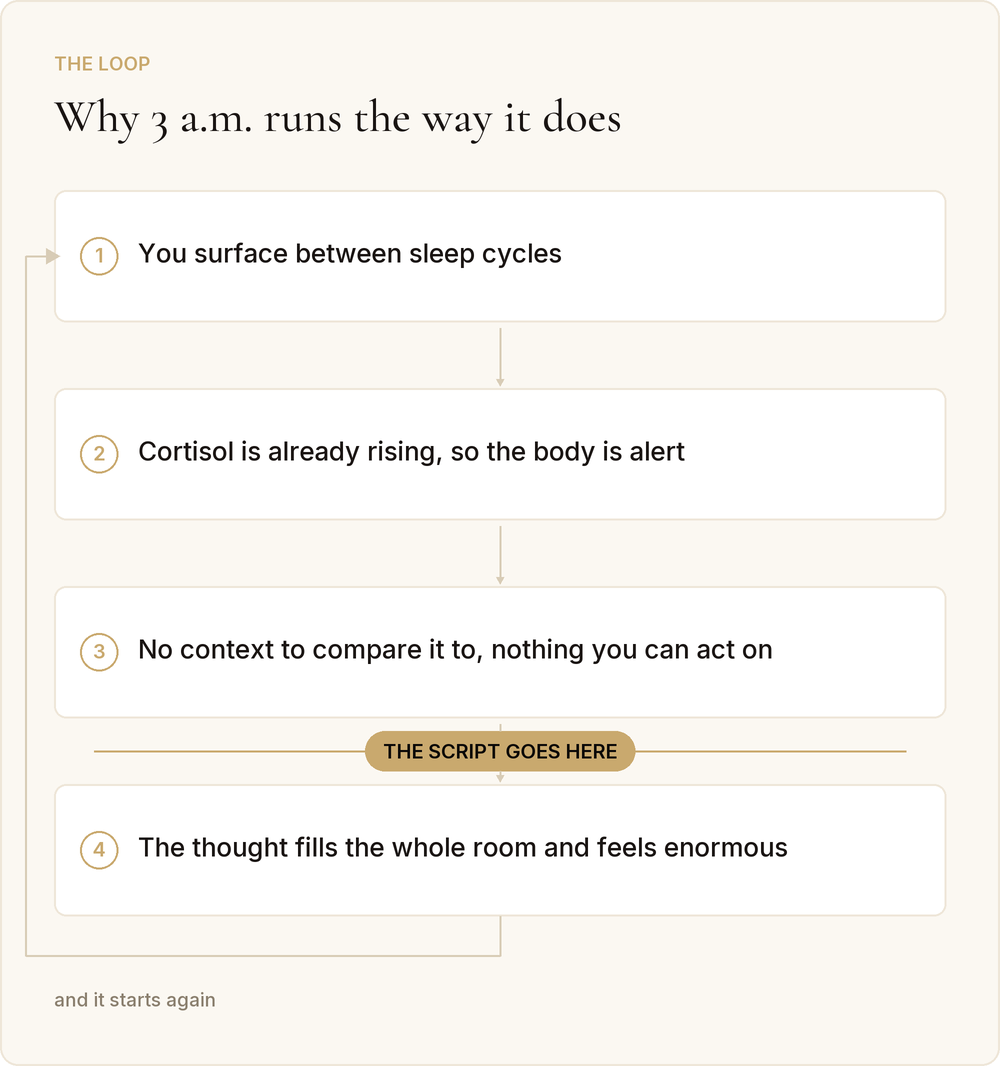
Sleep is not one flat state. It runs in cycles of roughly ninety minutes, and the back half of the night is weighted toward lighter, dream-heavy sleep. You surface between cycles many times a night, most of the time without noticing. In the second half of the night you are surfacing from shallower water, so it takes much less to bring you fully awake -- a noise, a temperature change, a full bladder, or nothing identifiable at all.
That is the waking. The staying awake is a different problem.
Your body runs on a daily cycle, and cortisol -- the hormone that gets you out of bed -- starts climbing in the small hours, well before your alarm. So you can wake at 3 a.m. into a body that is already beginning its morning preparation: heart a little faster, mind a little sharper, no reason for any of it.
Your brain, finding itself alert in the dark with nothing to do, goes looking for the problem. And it always finds one, because there is always one.
Why The Thoughts Feel More True At Night
This is the part worth actually learning, because it changes what you do about it.
At 3 a.m. you have three things working against you at once.
You have no context. During the day, a worrying thought arrives alongside a hundred other inputs -- work, weather, someone talking, the thing you have to do at four. At night the thought arrives into an empty room. Nothing competes with it, so it takes up all available space, and size feels like importance.
You cannot act. Every problem your brain raises at 3 a.m. is one you can do precisely nothing about until morning. You cannot send the email, check the balance, or have the conversation. So the loop cannot resolve. It just runs.
You are tired, which is a mood. Fatigue does not only make you sleepy. It reliably makes things look worse. The same fact -- the same unpaid bill, the same awkward exchange -- gets a bleaker reading from a tired brain than a rested one. This is the single most useful thing to know at 3 a.m.: you are not seeing it more clearly, you are seeing it more tired.
What Not To Do
Do not try to settle it. This is the instinct and it is the trap. The thought arrives with what feels like real urgency, so you start working the problem, and now you are doing cognitive work in bed, which is exactly the condition your brain will remember tomorrow night.
Do not check the time. It converts a vague discomfort into arithmetic. Four hours and ten minutes left. Now you are not just awake, you are behind.
Do not open your phone. You know this one. The screen is the least of it -- the real damage is that you have handed a bored, alert brain an infinite supply of new material.
And do not lie there fighting it past about twenty minutes. If you are still wide awake and winding tighter, getting up and sitting somewhere dim and dull for a while is genuinely better than teaching yourself that bed is where the struggle happens.
Five Scripts For The Middle Of The Night
These are short deliberately. At 3 a.m. you cannot hold a long argument. Say one, then let it go.
"I am awake at the hour I am usually awake. This is a sleep cycle, not a warning. Nothing has happened."
Catching it early matters more than anything else here. Once the loop has thirty seconds of momentum it is much harder to interrupt than it is at second three.
"There is nothing I can do about this before morning. Not one thing. Thinking about it now is not preparation, it is just suffering with extra steps. It will still be there at eight and I will be better equipped then."
Name the uselessness directly. The loop keeps running partly because it feels productive -- as though enough turns around the problem will produce a solution. It will not, not at this hour.
"My heart is fast because my body started its morning early, not because something is wrong. I am not in danger. I am just awake."
The racing heart is often the thing that convinces you this is serious. Naming it as ordinary physiology takes most of the charge out of it. Longer, slower out-breaths than in-breaths will help the rest.
"This is the tired version of me talking. It always sounds like this at 3 a.m. and it never sounds like this at noon. I do not have to accept a verdict handed down by a brain running on four hours."
The 3 a.m. inner critic is unusually harsh and unusually confident. Both are symptoms of the hour, not evidence.
"Lying here resting is not nothing. I am allowed to not be asleep. If sleep comes it comes, and if it does not, I have had bad nights before and got through the next day."
Most of the second hour of being awake is not insomnia. It is frustration about insomnia. Taking the pressure off the outcome is often the thing that lets it happen.
One honest caveat: waking regularly with a pounding heart can have medical causes -- sleep apnoea, thyroid problems, blood sugar, alcohol, and some medications among them. If this is most nights, or you wake gasping, or you are exhausted all day, see a doctor rather than a self-talk article. And if the night thoughts turn to harming yourself, in the US you can call or text 988 at any hour.
Why This Is Hard To Do From Memory
Everything above is easy to agree with at four in the afternoon and nearly impossible to produce at 3 a.m.
That is not a discipline problem. Generating calm, structured language is exactly the function that a half-asleep brain does worst, and it is the function you are asking it to perform against a loop that requires no effort at all. The loop is automatic. Your counter-argument is not. That is an unfair fight and it is why people lose it for years.
The fix is to stop generating and start receiving. If the words are already recorded, you do not have to think of them -- you just have to press one button in the dark and let a voice that is not yours take over the channel the loop is using.
Night Calm Reset is twelve minutes built for exactly this: eyes closed, low volume, no instructions to follow, nothing to do. Most people do not reach the end of it. That is the intended outcome. It is $14.99 and it is yours once you buy it.
If the daytime version of this is also familiar -- the spiral that runs while you are trying to work -- the membership is $9.99 a month for the whole library, including this and Overthinking Shutdown. It cancels in two clicks.
Key takeaways
- Waking between two and four is normal sleep architecture, and rising cortisol means you can wake into an alert body for no reason at all.
- Night thoughts feel truer because you have no competing context, you cannot act on anything until morning, and fatigue itself makes everything read worse.
- Do not work the problem, check the clock, or open your phone. Past about twenty minutes of winding tighter, get up and sit somewhere dim.
- Keep the scripts short. Catch the loop in the first ten seconds, name that nothing can be done before morning, and treat the racing heart as physiology rather than proof.
- Producing calm language is the exact thing a half-asleep brain cannot do, which is why a recording beats remembering.
There's an audio for this exact pattern.
Every essay connects to a guided self-talk audio that does the work repeatedly — because reading about a pattern doesn't rewrite it. Listening does.